A Year in Dublin’s Botanic Gardens
Updated: Aug 27
What's wonderful about visiting a garden is that it is different every month of the year. Some plants will completely die back in winter, and this is when evergreens and ornamental grasses come into their own. Other plants start to flower in spring and many peak in summer. And then some plants are their best in autumn, due to either late flowering or the striking colour of their leaves.
We’re very lucky in Ireland to have free access to the National Botanic Gardens in Dublin. Last year, I visited every month, and here are some highlights from each visit.
Hopefully, this will give you some inspiration and perhaps help when choosing plants for your own garden. Seeing how plants perform at different times of year is a great way to get ideas for creating a garden with interest across all four seasons.
January: Winter Structure
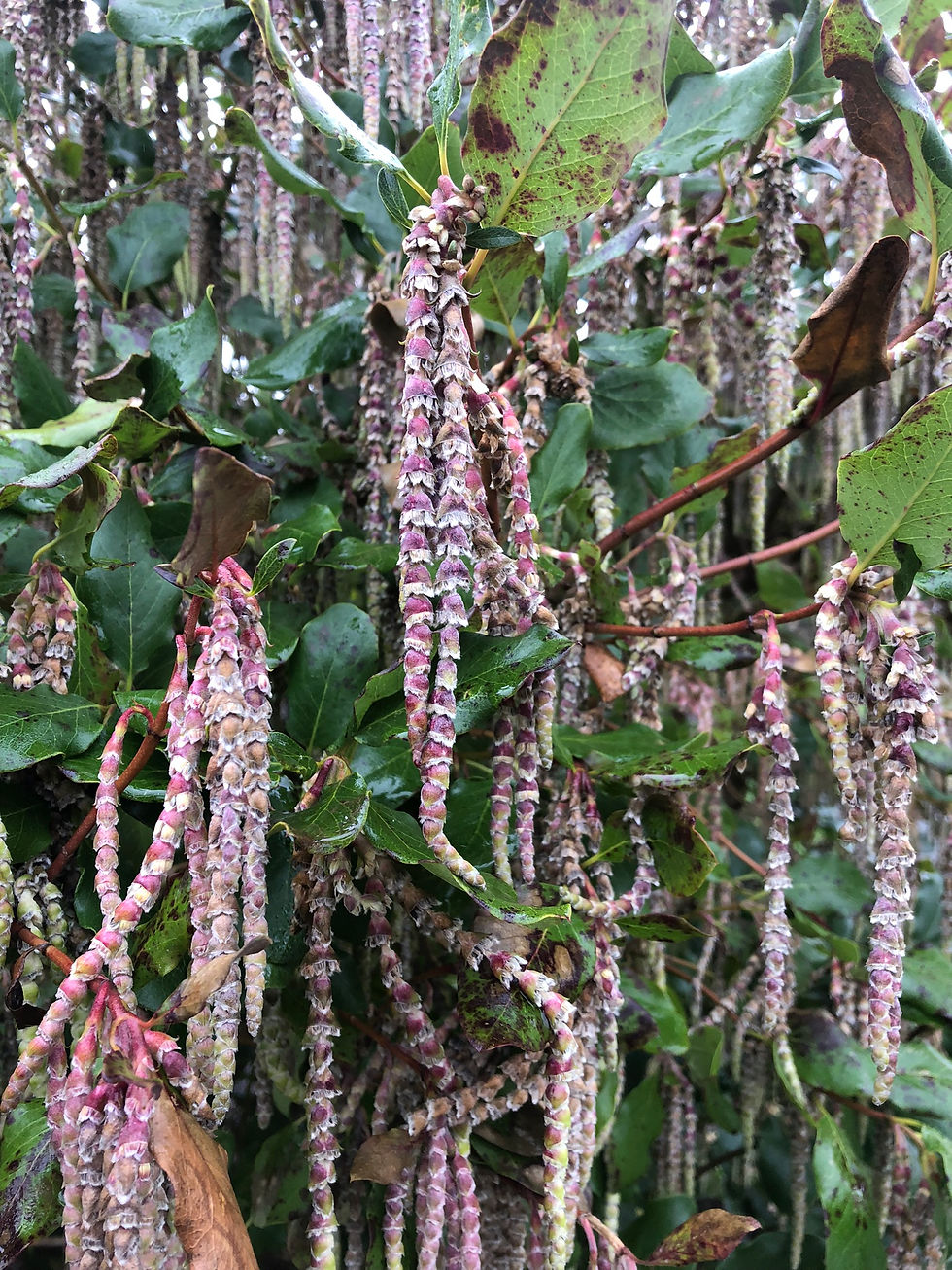
This cultivar of the silk-tassel bush (Garrya issaquahensis ‘Glasnevin Wine’) was first germinated in the Botanic Gardens (1). In January, its long, red-grey catkins hang clearly against evergreen foliage, making an eye-catching sight.

Plants chosen for shape and texture come into their own in January. The ornamental grasses in the Grass Border are left standing through winter. Their seed heads and stems give movement even on still days. I recommend you leave grasses in your garden during the winter too. Cut them back to the ground in February or March, before the new growth begins.
February: Early Colour from Evergreens

In February, evergreen shrubs begin to take on a more active role. Euphorbia characias subsp. wulfenii produces tall stems topped with yellow-green bracts that hold their colour for weeks and cope well with cold, wet conditions. This is a useful evergreen plant to provide unusual structure. Always wear gloves when handling Euphorbias as the milky sap of all Euphorbias is a skin irritant.

Arbutus trees are grown as much for their bark as for their flowers, with smooth, peeling stems in shades of orange and brown. Growing to six metres tall, it is suitable for a medium to large garden.
March: Signs of Spring

March brings the first clear signs of spring growth. Saxifraga scardica is an alpine plant growing in the Botanic Gardens Rock Garden. It has tight small pale yellow flowers and likes well-drained, sunny locations.

Ribes speciosum has dangling fuchsia-like red flowers that are particularly noticeable before surrounding shrubs come into leaf. It will flower from March to May and likes sun to semi-shade.

This quince, Chaenomeles × superba, has been trained to grow along a fence in front of the Director's Residence in the garden. It has scarlet-red flowers that pop in early spring. The plant is valued for its toughness and long flowering period.
April: Woodland and Border Plants

April sees strong growth across the garden. Wild garlic, Allium ursinum, spreads naturally through shaded areas, forming a dense carpet of fresh green leaves and white flowers that attract early insects. It is vigorous, so it is best to plant in areas where you are happy for it to spread; this vigour makes it a useful ground cover in large woodland areas (ie under trees).

Elephant's ears, or Bergenia crassifolia, are evergreen plants that provide good ground cover in shaded areas. They have striking pink flowers from February to May.

The tree peony, Paeonia delavayi ‘Anne Rosse’, only flowers for a short period of time, but its very elegant flowers make it a worthwhile shrub.
May: Trees and Tall Perennials

The Handkerchief tree, Davidia involucrata, is in its full glory in May with billowy white flowers which can be seen clearly even from a distance. This tree grows to about 10 metres and is only suitable for very large gardens.

Bistorta officinalis, produces a stunning display upright spikes of pink-purple flowers. It is vigorous, so it best to plan in areas where you are happy for it to spread.

Ornamental alliums provide great colour and interest to a border at a time when many other plants are not in flower. Their purple rounded heads are rising above surrounding planting in this border.
June: Early Summer Planting

I find that Astrantia major does best in semi-shade, rather than sun, as it likes moist soil. In the right conditions, it will flower from June to September.

Anemone sylvestris is a woodland plant, ideal for growing under deciduous trees.

Chinese dogwood (Cornus kousa var. chinensis) is a beautiful tree that will eventually grow to six metres tall and six metres wide. It is in full bloom in June.
July: High Summer

July brings fuller borders and stronger colour. Knautia arvensis is a native Irish long-flowering meadow plant that supports pollinators and copes well with mixed planting.

The rose beds in the Botanic Gardens are one of my highlights of the garden in mid-summer. It is maintained to a really high standard, with regular pruning and a generous mulching of manure.
August: Mature Borders

The Victorian Border at the entrance of the gardens is particularly colourful in August, with dense planting of mostly annual plants such as marigolds (Tagetes), sunflowers, and the foliage plant Ricinus communis ‘Carmencita Bright Red'.

Eupatorium purpureum grows to about 2 metres and is a nice addition to add height and structure in a border. Its rosy-purple flower heads are attractive to butterflies and other beneficial pollinators. However, snails love it, so you may need to protect the plant when the tender new growth appears each year.
September: Late Summer Colour

September continues the theme of strong colour. Amaranthus ‘Velvet Curtains’ is an annual plant that provides deep red foliage and flower spikes. It will contrast beautifully with surrounding greens. I'm going to grow this plant from seed next year as it is so beautiful.

Dahlia borders are in full flower in September. I don't grow dahlias in my own garden as I think the slugs in my garden have super powers and they gobble them up! So it is nice to enjoy dahlias in public gardens such as this.
October: Reliable Autumn Performers

October still offers plenty of interest. Salvias remain in flower well into autumn, especially in milder years. Most salvias will survive a typical winter on the east coast of Ireland where temperatures rarely drop below -5 degrees.

Asters, including cultivars such as ‘Island Samoa’, provide late nectar and help maintain colour in your garden as other plants fade.
November: Leaves, Bark and Evergreens

In November, attention shifts to foliage, bark, and evergreen structure. Some deciduous trees have gorgeous Autumn colour as their leaves turn shades of orange, red and yellow before their leaves fall.

Trees with gorgeous barks, such as Chilean myrtle (Luma apiculata), really stand out in winter when other plants have died back. They help prevent the garden from feeling bare as winter approaches.
December: Winter Interest

December brings the focus back to winter-flowering and evergreen plants. This lesser-known Mimosa tree, Acacia baileyana, originally hails from Australia. In December it is showing its bright yellow flower buds. It has lovely, soft fern-like foliage. It grows to about six metres so would be suitable for a medium-sized garden.

This holly, Ilex aquifolium ‘Handsworth New Silver’, provides variegated foliage and loads of bright red berries that stand out even on dull days. It can be grown as a hedge or a tree.

Another silk tassel caught my eye. Garrya issaquahensis ‘Pat Ballard’ (1) has striking long, decorative catkins that hold through cold weather. This cultivar was named by Lord Talbot of Malahide Castle, (the village I grew up in).
Seen over the course of a year, the Botanic Gardens in Dublin show how careful plant selection and timing create interest in every season. With some thoughtful planning, a garden can be built around plants that perform reliably month after month in Irish conditions.
If you’d like advice on choosing plants for your garden, I offer planting scheme designs and garden consultations. I can help you choose plants that suit your garden’s conditions, your preferences and the amount of maintenance you want to do!
Please fill out this form or email me at elaine@plantplanner.ie
(1) Source: Irish Garden Plant Society


